| |
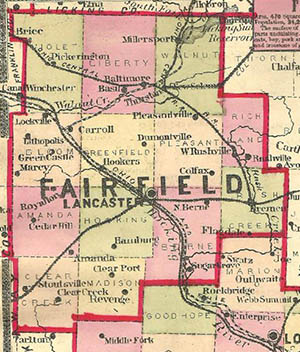
Selections from the "Contribution of Thomas Cole of Amanda Township" from a Complete History of Fairfield County, Ohio by Hervey Scott, Royalton, March 13th, 1877.
...Tradition says nothing of the origin of the village [Toby Town], but in about 1806, or 1807, the Indians left it...shortly after they left, William Clark built, on the old village site...the Clark family, who settled within thirty rods of them in 1799, were never seriously molested by the red-skins...
In the spring of 1800, three men, names not remembered, came from near Chillicothe and broke ground on the prairie in section number 4, planted corn, and then returned home. They came back in due time and tended their corn twice.
The next fall one of these men sold his share to Horatio Clark, receiving a horse in payment. The other two likewise disposed of their shares to parties not now remembered. In November of the same year, Wilkinson Lane, of Huntingdon County, Tennessee [sic should be Pennsylvania], settled on section 8, and was succeeded in the month of June following by Thomas Cole, my grandfather, who had entered the section. His grandchildren still own one half of the section. The family were never troubled by the Indians.
In a few years my grandfather built a school-house on his land, hired a teacher, Abraham Cole, for eight dollars a month, and then invited all who wished to send their children and pay a pro rata share, or not, as they could or would. In those days school hours were from "sun to sun," or as soon as scholars arrived...That house was built on the north part of section 18.
David Swope [married Mary Cole] and William Long were settlers on section 8, in June, 1807.
In 1800, Dr. Silas Allen bought and settled on section number 3, building a house on the crest of a hill, near the western line of said section, and fronting a prairie on the west, in section number 4. His purchase consisted of about five hundred acres. At that time there was not the mark of an ax from Lancaster to his house. Said section was soon given to his four sons-Whiting, Lemuel, Jedediah and Benjamin Allen. Lemuel and Jedediah gave ground for a village, and about 1810
William Hamilton, then living on section 22, surveyed and laid out the village of Royalton, about one mile south-east of Toby Town. For some years it went by the name of Toby Town, generally, but by the Allen family it was called Royalton, after a village in Vermont, from whence they came.
Elvira Allen, now Mrs, Meeker, was born in 1803, the first female child born, it is supposed, in that part of the township. Mrs. Meeker still distinctly remembers the Toby Town Indians coming over the prairie in single file, the squaws carrying their papooses on their backs, lashed to a board, and on arriving at her father's house, would stand up the boards upon which their little responsibilities were tied, against the outside, while they went in.
The first schools in Royalton were taught by Warren Case and his sister Sabre, in 1810; and by Henry Calhoon, in 1812. The Rev. Dr. Hoag, (late of Columbus) a Presbyterian, preached in Lemuel Allen's house, in Royalton, as early as 1810. About the same time the first tavern was opened there by Lemuel Allen, as also the first store by Jacob Rush.
In about 1814, the Methodists organized a society there, and their first preacher is supposed to have been Isaac Quinn. In this year Stephen Cole built a grist-mill and a carding machine combined, on what is called Cole's Run, heading at a spring in section 8, the mill being situated on section 7.
Richard Hooker helped to build the mill; and in 1817, Piper and Reynolds built what is known as the Hooker mill, on Turkey Run. Mr. Hooker lived on section 19. The mill has long since disappeared, only bare traces of it being now visible. Mr. Richard Hooker, now of Hocking Township, and in his 79th year, assisted in digging the mill-race. The first horse grist-mill and still-house were situated in the south part of the township, and were owned by a Mr. Huffer, the exact date of their erection not being known. Richard Hooker was a Justice of the Peace for the township at a very early day. I have recently seen a deed, dated November 15, 1805, the acknowledgment of which was taken by Jesse Willets, J. P. Hamilton and Rush were also Justices for Amanda Township.
On the 6th day of September, 1817, Elders Eli Ashbrook and Jacob Tharporganized the Turkey Run Regular Baptist Church. This church is still in existence. They held their meetings in Hooker's school-house as late as 1838, about which time a house of worship was erected. None of the original members are now living, and but one now lives who became a member by letter a year or two afterward, viz.: Permelia Ashbrook, now 83 years old. Elder Eli Ashbrook, one of the original founders of the Turkey Run Church, died in January, 1877, aged 96 years.
In 1803 Valentine Reber came out from Pennsylvania, and entered section 10 of our township, and in 1805 he brought out his young wife from Berks County and settled on the section. Frederick Leathers settled in the southern part of the township, about the year 1800. . .
Mr. Henry Kiger and his wife, aunt Polly Kiger, are residents of Amanda Township, though they were not among its first settlers. Mr. Kiger is now nearly ninety-seven years of age, and his wife is about six months younger. She is quite brisk, and able-to walk several miles to visit her children. The old gentleman is rather feeble. From a personal interview had with them last Monday, March 5th, 1877, I took the following from their lips: When nearly nineteen years of age, she was living in Hancock Town, with an Irishman whose name was James Foley, and who was a tailor. She was there for the purpose of learning the trade. On one occasion General Washington came there on some business connected with the "Whisky Boys." The General put up at Johnston's Tavern, and presently came to Foley's to have his suspenders mended. Foley passed them to Polly Walduck (now Mrs. Kiger) to be repaired. They were profusely ornamented with silver. When she returned them, the General inquired of Mr. Foley if the young lady was his daughter. He replied that she was not, but that she was a mighty fine girl,
then the General put his hand on my head, and called me a pretty girl, which made me mad, though I made no reply.
Mr. Kiger was in the War of 1812, serving seven months. His company was encamped three weeks at Washington City, after the burning of the Capitol by the British, in 1814. He says he walked up the stone steps of the burned Capitol frequently and viewed the ruin.
Statement of Wesley Peters of Hocking Township
My father [Samuel Peters] came from Baltimore County, Maryland, in the year 1812, and settled first in Rush Creek Township, in this county. In 1817 he removed to Amanda Township, locating on Clear Creek, one and three-quarters of a mile south of the village of Royalton.
He was the father of nine sons, viz.: Henry, Robinson I., Nathan, Wesley, Stephenson, Andrew, Gideon, Lewis and Ebenezer. His four daughters were: Rachel, Leah, Mary and Elizabeth. Of the sons, eight are living, in April, 1877, Gideon having deceased in 1844. The four daughters married as follows: Rachel married William Broomfield; Leah married Broad Cole; Mary married Daniel Walters, and Elizabeth married Newton Williamson. William Broomfield deceased about the year 1874.
His sons at present residing in Fairfield County, are: Robinson I., Wesley and Andrew; Lewis and Stephenson reside in Pickaway County; Henry in Upper Sandusky, and Nathan and Ebenezer in Marion, Marion County, Ohio.
I mention as my father's neighbors, at the time of his settlement in Amanda Township, in 1817, Valentine Reber, Jos. Huffman, Jacob Restler, Abram Myres, George Disinger, Squire Stevens, Squire William Hamilton, Jacob Prestler, Mr. Hanaway, Jesse Hutchins, Jacob Schleich, Thomas Galaher and Mr. Huber. These were all citizens of Amanda Township. They have all passed away.
Statement of Samuel Kester of Amanda Township
My father, George Kester, was one of the first settlers at Yankee Town, now Clay pool's neighborhood, in Greenfield Township. He first settled on the Richard Hooker place. This was in 1799. Subsequently he bought land in Amanda Township, the same on which I now reside, three miles east of the village of Royalton, where he died in April, 1852, at the age of 72 years. I am his only surviving son. I was born in Fairfield County, and have lived on the same place all my life. "
There was a little log school-house on Kemp's land, near our place. It was the first place I yent to school. The first teacher I remember there was James Granthum. It was in 1852. The logs of that little school-house were removed and rebuilt on the Jesse Spurgeon place, two miles west of Lancaster, near the Cedar Hill pike, where they still stand. The next school I attended was on the Hutchison farm. A teacher there that I remember, was John Cunningham. The logs of that house are now used as a stable near the pike, three miles east of Royalton.
The first religious meetings I remember were held in a log school-house in Royalton, by the Lutherans. The Methodists had a society there. They sometimes held their meetings in barns. The United Brethren preached at the houses of George Grow and Jacob Bullenbaus. This was from 1828 to 1832.
The first funeral that took place in the Yankee Town settlement, was in 1801 or 1802; I have forgotten the man's name. He died on Black Lick, in what is now Licking County. He came out with the company that settled at the Claypool place, or was a relative, and they brought his remains down there for interment. There were no roads, and the body was brought by two horses, in the following manner: Two long poles were cut. A wagon-cover was made fast to them, after the manner of a hammock; upon this the body was laid, and the poles suspended on the backs of the horses, which were prepared with pack-saddles, one horse before, and the other in the rear. The distance was several miles. There was neither planks nor cabinet-makers in the settlement, and a coffin was improvised with slabs split from large trees. The slabs were set in the dug grave, the body lowered, and a wide slab laid for the lid, upon which the clay was filled in. This statement I received from my parents.
The first wedding I remember was that of my uncle, Jacob Harrison, to Julia Ann Hanaway. She died six weeks afterwards.
Wolves swarmed all over the country at the beginning of the settlements, and for a number of years subsequently. For some time after my father built his cabin, there was no door-shutter, and to close the opening, called the door, a wagoncover was suspended in it. Wolves howled around daily. When sheep were first introduced, they were herded and watched through the day, and shut up in a strong log-pen at night, to preserve them from the jaws of the wolves.
The first years in the Yankee Town settlement the ague [malaria] attacked almost everybody, and that was the principal reason why my father moved further west. The following were the principal first settlers of that section of what is now Greenfield Township: Father McFarland, who was the father of the late Walter-McFarland; Mr. Cherry, and others I cannot now name. Our neighbors in Amanda Township, at my first recollection, were Tunis Newkirk, father of Jephthah Newkirk; Grandfather Kemp, Henry Kemp, Theodore Williamson, Henry Ingman, Henry Kiger, William Kiger, Richard Herrod, Widow Osborn, who was familiarly known as Granny Osborn. (She was one of the very first settlers.)
Deer and wild-turkeys were abundant; and occasionally a bear. Wild-cats were quite plenty; hawks were very troublesome in the destruction of chickens.
Or first grinding was done at the rock-mills. But in the very early times the men went all the way to Chillicothe to mill, packing their grists on horseback. Salt was first brought from Zanesville, on horseback. It cost from $3 to $5 for fifty pounds, which was called a bushel.
First roads were made through the woods by following the blazed trees from cabin to cabin. Dancing was practiced to some extent by the young people; and we played the old plays of "Sister Phoebe," and kindred plays. It was no uncommon thing for the young people to go to church, or "meeting," as it was called then, barefooted; and older people too, in some instances. The reason for this was the scarcity of shoes, as well as the inability on the part of the people to always command the means of paying for them. Our manner of living was in accordance with the general pioneer life of the times. The old time hominy-block was found in every cabin, and spinning-wheels, and reels, and the corn-grater. Our clothing was mostly home-made. We had to work hard, and had very little time for play. The wants of the people were fewer than at present, and more easily met, for our real requirements were natural, and we were satisfied.
Statement of Samuel Griffith of Amanda Township
My father, Isaac Griffith, emigrated from Lancaster County, Pennsylvania, in 1818, and settled in Amanda Township, on the place known as the Leathers Tavern, adjoining the present village of Amanda on the south-east corner. At that time the site of Amanda, and all the surrounding country, was in a wild condition, There were a few small settlements in different parts of the township, mostly living in rude log-cabins, and small farms were opened; but there were neither good roads nor markets.
The best house in the community was the Leathers house. It was of hewed logs, and two stories high. Mr. Leathers settled there at a very early day, and had kept a tavern many years. At the time of our coming there was neither a frame nor a brick building in the township. My father kept tavern in the Leathers House about twenty-five years, or until his death, which occurred in 1855. The house burnt down in 1858 or 1859.
Our neighbors at the time of coming there, in 1818, were Abram Kestler, Abram Myres, John Welsheimer, Frederick Welsheimer, David Leathers, Samuel Leathers, Mr. Gardner, William Hamilton, Michael Shellenbarger, Martin Landis, Judge Vanmeter, John Leist, Samuel Kirkwood, John Swoyer, Daniel Conrad, John Conrad, Michael Nigh, Samuel Nigh and Daniel Peters.
The first school I went to was in the Landis neighborhood. The first teacher was Moses Stutson, and afterwards Solomon Grover. I was a very small boy, but I walked over the road twice every day. The house was made of round logs, and one log was cut out for a window. The first church was built on Swoyer's land, in about 1828. It was a brick house.
I have known oats to be sold for six and one-fourth cents per bushel, after we came here, though the price was usually about twelve and a half cents, but seldom in cash. There was very little cash in the country. Everything was done by trading. Wheat was sold at twenty-five cents per bushel. A day's labor was twenty-five cents in trade, except in harvest-time, when a half-dollar was paid, for the most part in money. The farmers usually contrived some means of getting money to pay the harvest-hands. I know it was much harder to pay the taxes then than now, although I believe it would not be out of the way to say that eight dollars of taxes then is represented by two hundred dollars now. Butter could sometimes be sold then for six and one-fourth cents. Our post-office was at Lancaster. There was one mail each way in a week. We brought our salt from Zanesville, and paid as high as five dollars a bushel for it.
|
|